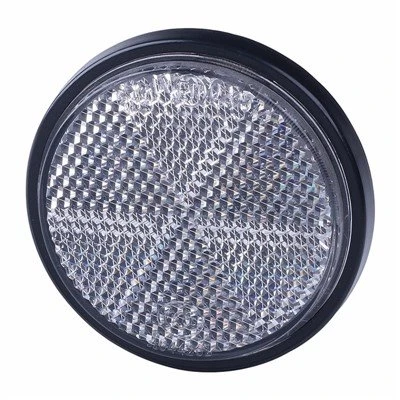
A hollow retroreflector is a specialized optical component designed to reflect incident light back along its original path; it achieves high-precision retroreflection even when there is some deviation in the angle of incidence. This characteristic makes it a critical component in fields such as laser ranging, optical positioning, optical communication, and precision metrology, particularly in applications requiring stable optical paths or minimal optical energy loss.
The core of a hollow retroreflector consists of three mutually perpendicular flat mirrors that form a hollow internal reflective cavity. When light enters from any angle, it undergoes three reflections between the mirror surfaces and ultimately returns along its original direction. Compared to traditional solid retroreflectors (such as corner-cube prisms), this structure offers lighter weight and greater design flexibility. They are typically manufactured using high-transmission, low-dispersion H-K9 optical glass, a material that maintains stable optical performance across the visible to near-infrared spectrum (400–2000 nm) while offering high hardness and scratch resistance for long-term use.
Key performance indicators for hollow retroreflectors include retroreflection efficiency, angular tolerance, and wavelength adaptability. Retroreflection efficiency can exceed 99%, meaning incident light energy returns with virtually no loss; angular tolerance is typically within ±5°, ensuring accurate retroreflection even with oblique incidence; and wavelength adaptability spans the visible to near-infrared range, meeting diverse application needs. Unlike solid retroreflectors, the hollow design minimizes thermal effects caused by material absorption, making it better suited for high-power laser applications; additionally, the hollow structure facilitates the integration of other optical components (such as filters) to further expand functionality.
In laser ranging systems, hollow retroreflectors serve as target reflectors, significantly enhancing measurement accuracy and range; in optical positioning equipment, their stable retroreflection characteristics enable rapid target location; and in optical communication, they are utilized for optical path alignment and signal feedback. Care should be taken to avoid contaminating the mirror surface during use, and specialized optical cleaning paper should be used for cleaning. During installation, ensure the reflection cavity remains unobstructed and that the deviation between the incident light direction and the retroreflector's axis falls within permissible limits. For long-term storage, keep the unit in a dry environment to prevent mold growth on the mirror surface or degradation of the coating.
Hollow retroreflectors are typically categorized by diameter, with common sizes ranging from 41.3 mm to 85 mm; while larger diameters produce larger return light spots, angular tolerance may decrease slightly. Users can select models based on specific requirements: for high-precision positioning, prioritize products with an error of less than 0.1 arcminutes; for outdoor or harsh environments, opt for fully enclosed models to enhance protection; and for rapid delivery, look for suppliers with ample stock capable of shipping within 48 hours. Additionally, some products offer customization options, such as adjusting mirror coatings for specific wavelengths or optimizing the structure to reduce weight.