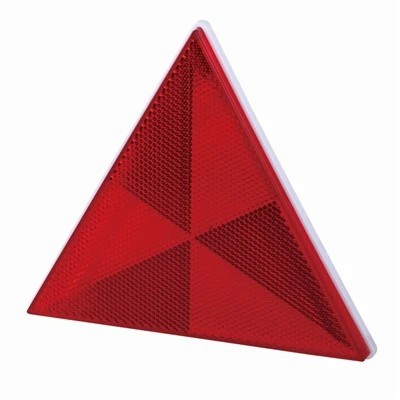
The triangular warning sign for motor vehicles-commonly known as the "warning triangle"-is a passive, reflective warning device used during vehicle breakdowns or accidents to alert following traffic to steer clear. It is a triangular device that emits a warning signal via reflected light, indicating that a motor vehicle has come to a stop. When stopping temporarily on a road, drivers should place the warning triangle 50 to 100 meters behind the vehicle; the reflected light serves to alert approaching traffic and ensure safety.
Placement distances vary by road type: 50 meters during the day and 100 meters at night on ordinary roads; 150 meters during the day and 250 meters at night on expressways (increasing to 200 meters in rainy or foggy weather). On expressways, placement should be determined using "hundred-meter markers" (circular signs with a green background and white text installed every 100 meters). On slopes, the sign must be placed at the crest or the bottom; in the event of an accident on a curve, it should be placed on the road surface before the curve begins. Under the *Administrative Measures for Point-Based Penalties for Road Traffic Safety Violations*, failure to set up the sign as required results in a 3-point penalty on ordinary roads and a 9-point penalty for illegal parking on expressways. Drivers must also activate hazard lights simultaneously, adding clearance lights and tail lights at night.
On May 23, 2003, the national standard Triangular Warning Signs for Motor Vehicles (GB 19151-2003) was issued; administered by the Ministry of Industry and Information Technology, it officially took effect on November 1 of that year. Early versions of warning triangles featuring an exclamation mark were classified as non-compliant products because they did not meet this standard.